A structured agentic development case study

From vibe coding to a system.

Distilled from building AbsolutePath, this system keeps natural-language speed, then adds what a prompt cannot safely hold: memory, boundaries, independent challenge, and production proof.

4 memory layers 3 independent repos Role-based agents Evidence feedback loop

01 / The usual flow

One path. Different roles. Evidence at every handoff.

The owner still begins with plain language. The system converts that intent into a sequence of durable contracts and increasingly expensive proof. Only independent work runs in parallel.

Lean system map Scroll horizontally on a small screen
01 / Owner

Intent

Define the outcome, constraints, risk, and the honest meaning of “done.”

Open calls decided
02 / Meta-agent

Context

Load current state, code reality, history, known traps, and repository boundaries.

Cold start, not blind
03 / Planning lead

Contract

Lock one shared contract; split atomic PRDs with OWNS / REFERENCES boundaries.

Dependency DAG
04 / Workers

Build

Use one fresh worktree per scope. Implement behind seams; turn criteria into tests.

Build → test
05 / Reviewers

Challenge

Inspect independently, try to refute the result, and fix only the affected delta.

Adversarial verify
06 / Release lead

Prove

Run exact-release gates, deploy, exercise the live path, and record honest status.

Production is truth
built on branch→merged→deployed→ production-verified

02 / Repository + memory architecture

Three boxes. Four kinds of truth.

The umbrella sees the system. PRD decides what. App records how. The bridge tells us what is real.
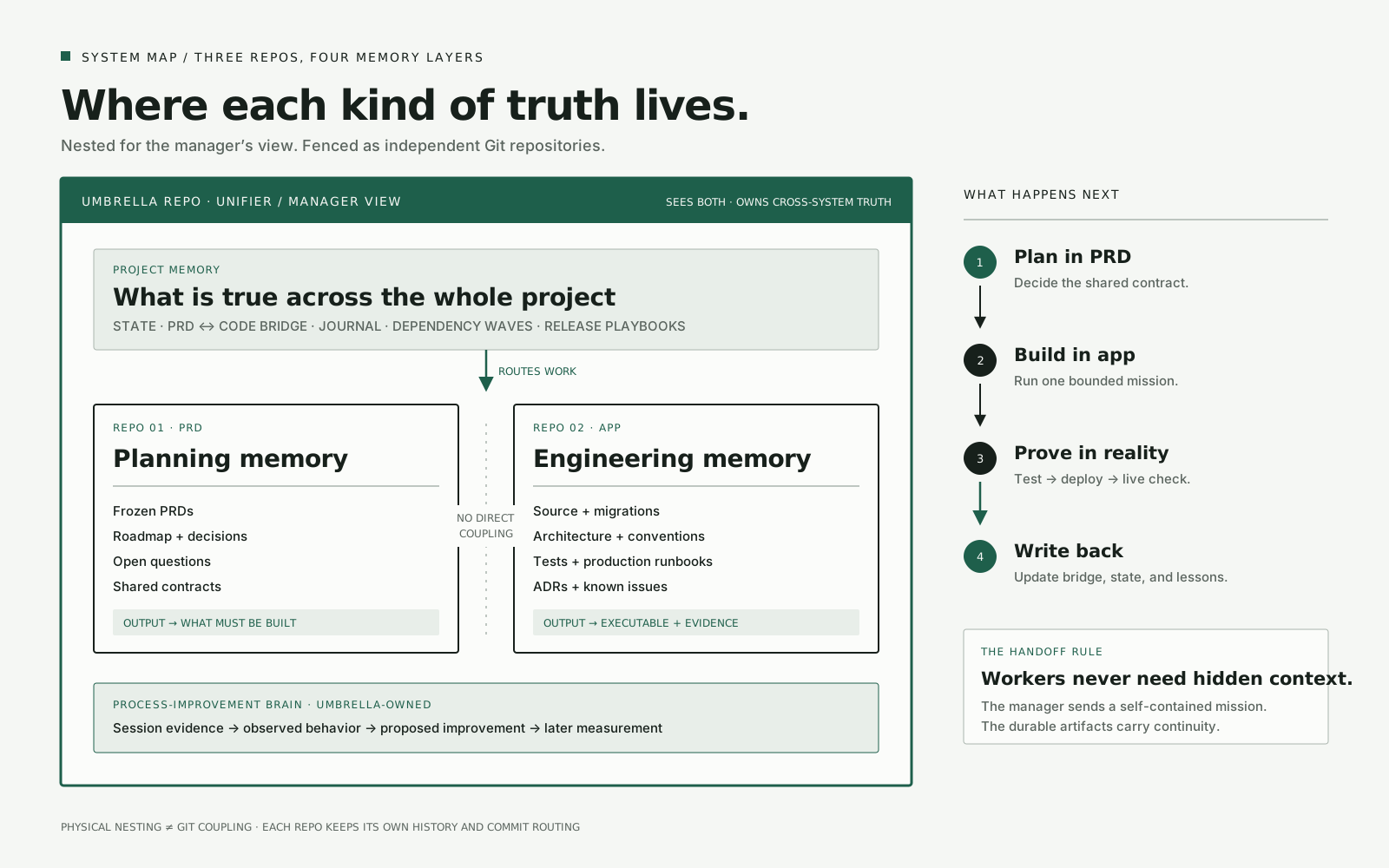
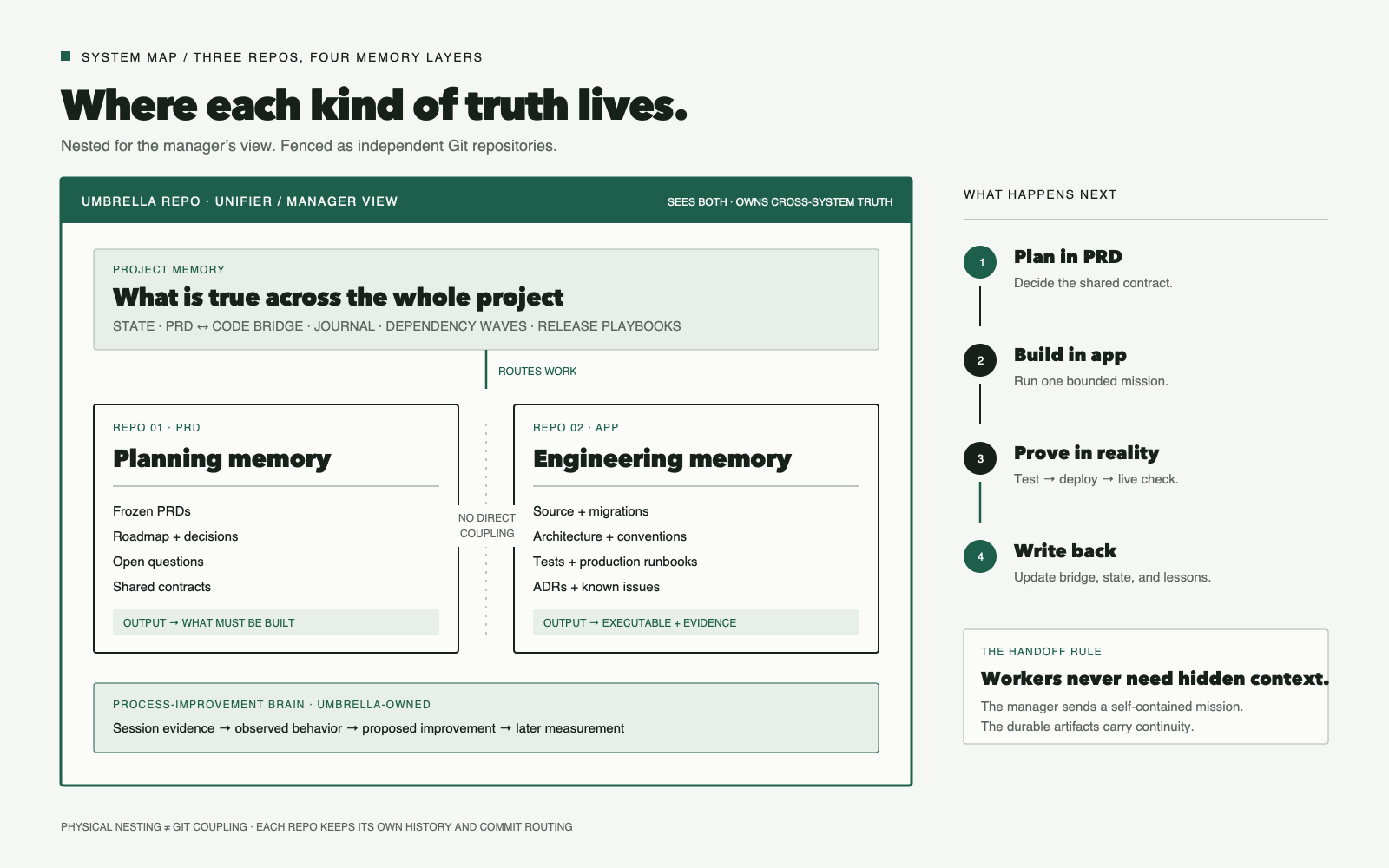
Nested diagram showing the umbrella manager view containing project memory, separate PRD and app repositories, and the process-improvement brain, with a plan-build-prove-write-back flow.
Independent repos · nested only for the manager’s mental model Swipe diagram → PNGSVG

03 / Agent orchestration

One manager. Bounded workers.

Workers build locally. Independent reviewers challenge the frozen candidate. The manager owns outward authority.
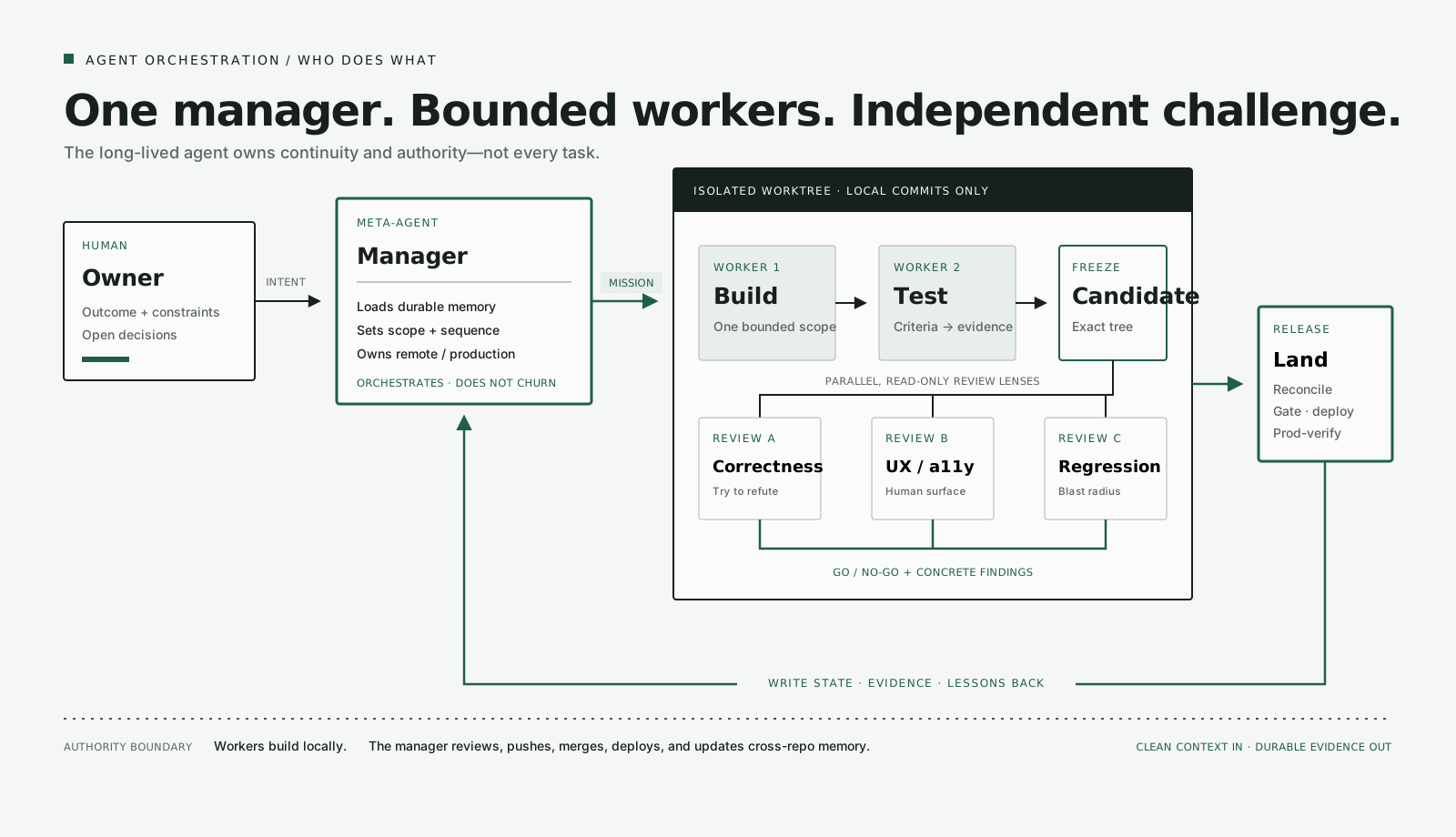
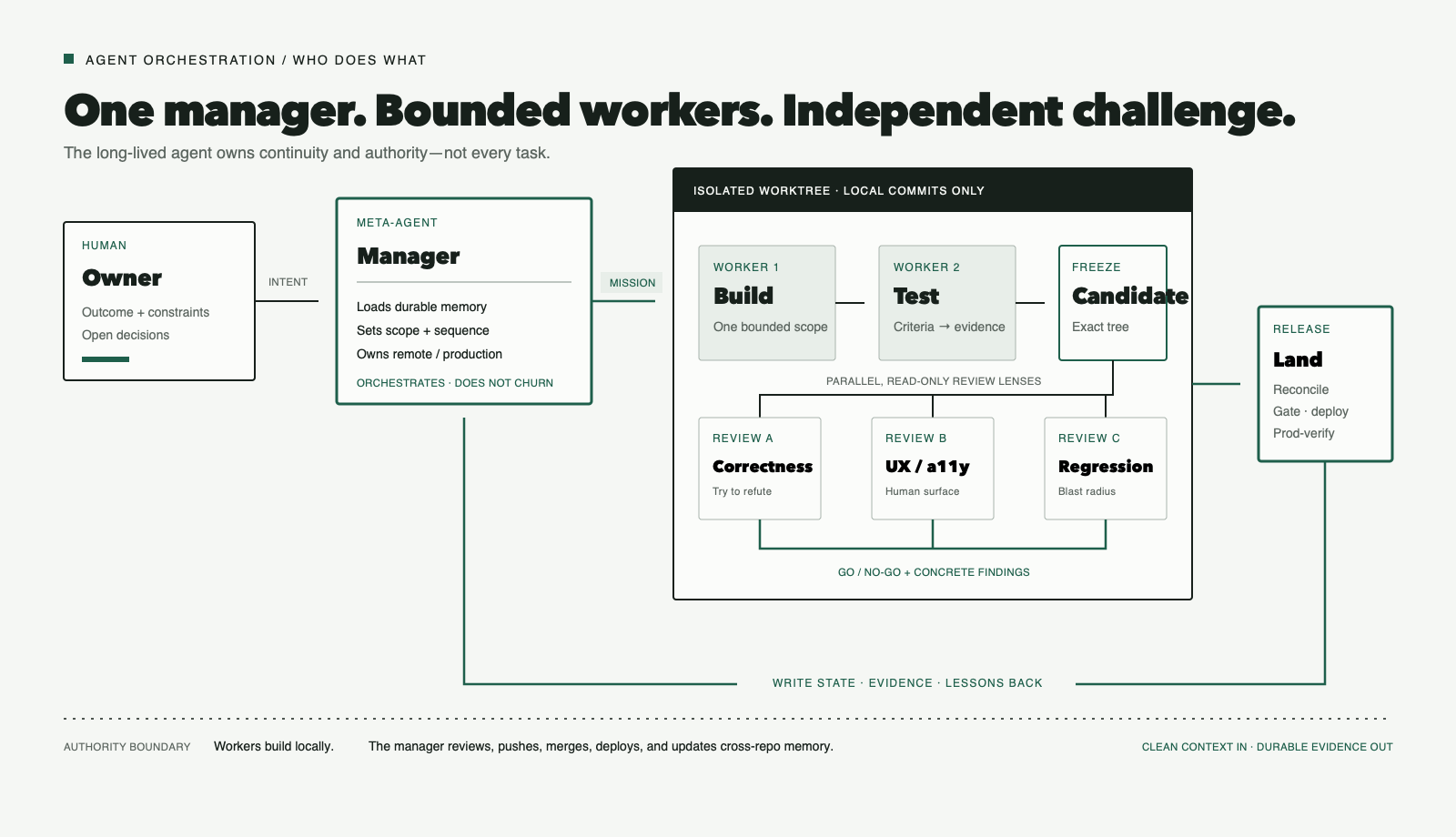
Flow diagram from owner to meta-agent manager to isolated worktree, where builder and test workers create a frozen candidate, three reviewers challenge it, and a release lead lands and production-verifies it before writing lessons back.
Clean context in · durable evidence out Swipe diagram → PNGSVG
Small changeDirect worktree pipeline.
Architectural changePRD before code.
Production actionManager or owner only.

04 / Failure → safeguard

Every guard has a scar.

Four recurring failure patterns, converted into simple operating rules.

FailureMapped a stale checkout
SafeguardFetch origin/main + read the live bridge first
FailureParallel branches collided in shared memory and numbering
SafeguardReserve scarce IDs · one writer · serial integration gates
FailureIn-memory tests passed; real database constraints could fail
SafeguardTest schema changes against the real adapter before merge
Failure“Green” badges hid skipped builds and non-executed CI
SafeguardRead execution evidence · prove the serving artifact moved

05 / The 40-hour signal

Coding was the small part.

Preliminary finding: safety stayed high, but assurance was repeatedly expressed in natural language.

Early signal · analysis still in progress

41 hours of assurance, not 41 hours of code.

Keep the safety. Automate the deterministic repetition.

Implementation2.791 agent-hours · 4 runs
8.8%
Review28.863 agent-hours · 29 runs
91.2%
41.023h elapsed33 subagent runs2.167M recorded output tokens
Next evolution · deliberately only a preview Proposed, not adopted
01Structured evidenceFacts recorded once
02Content-aware gatesRerun only what changed
03Delta reviewReopen affected lenses
04Agent judgmentReserved for semantic risk

06 / A reusable starting point

Start with four artifacts.

You do not need the full system on day one.

01 / MEMORYSTATE.mdWhat is true now + next action
02 / CONTRACTOWNS / REFERENCESScope and acceptance criteria
03 / PROOFTEST → REVIEW → PRODA visible status ladder
04 / LEARNINGDECISIONS + ISSUESThe next agent starts smarter

07 / Bring it into your project

Give your coding agent this prompt.

It confirms the project, estimates the adoption, helps you choose a scope, waits for approval, then installs and teaches the workflow.

01 / PASTEOpen your workspacePaste the prompt where you normally develop. The current folder is only a candidate.
02 / CONFIRM + ESTIMATEAgent asks, then assessesOne agent runs one bounded read-only pass, then explains effort and likely agent usage.
03 / APPROVE + LEARNYou stay in controlOnly after approval does it install, validate, and guide a small pilot task.
Download .md
Preview the complete workflow setup prompt
workflow-setup-prompt.mdAdapt, do not blindly copy


When you use this, the agent will:Ask → Assess read-only → Estimate → Choose scope → Approve → Install → Guide a pilot.
Setup prompt copied